WestProp Holdings chief executive Kenneth Sharpe has issued a stark warning that Zimbabwe risks remaining locked in poverty unless it finds ways to convert its vast property wealth into usable capital, arguing that billions of dollars currently sit trapped in homes that cannot be leveraged for economic activity.
Speaking at the sixth edition of the ZimReal Conference, Sharpe said Zimbabwe had vast property wealth but very limited mortgage financing, leaving homeowners “paper rich” while struggling to access cash. He described mortgage lending in the country as almost negligible, accounting for less than 1% of Zimbabwe’s real estate market, calling the figure appalling once broken down in real terms. According to Sharpe, Zimbabwe has an estimated US$100 billion worth of homes, including between US$20 billion and US$30 billion in Harare alone, with very little mortgage lending secured against those properties.
Sharpe framed the issue using economist Hernando de Soto’s concept of “dead capital”, arguing that without financing mechanisms to unlock the value tied up in property, citizens remain wealthy on paper but cash-poor in practice, a dynamic he said keeps the broader economy from realising its potential.
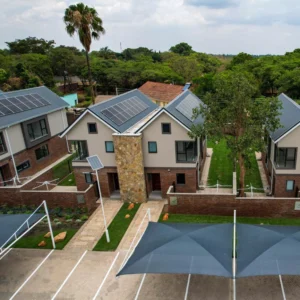
To address the gap, Sharpe announced that WestProp had established West Cap Mortgage on the Victoria Falls International Financial Centre platform, with plans to make the mortgage business operational next year. The company intends to bring a billion-dollar fund onto the platform, offering long-term financing not only to WestProp’s own developments but to homebuyers across the wider sector. WestProp’s existing mortgage book currently stands at around $30 million, a fraction of the scale Sharpe hopes the new bank will eventually reach.
Sharpe pointed to Zimbabwe’s chronic housing shortfall, estimated at between 1.5 million and two million units, with Harare and Bulawayo accounting for roughly seventy percent of the backlog, as evidence of the urgent need for long-term, patient capital in the property sector. He cited Switzerland as a model of how mortgage financing can transform static property assets into productive economic capital, enabling homeowners to borrow against their homes and reinvest in businesses or other ventures.
Widening his argument to a continental scale, Sharpe noted that Africa has about 130 billion dollars of mortgages on a continent with over 10 trillion dollars of assets, describing the imbalance as a missed opportunity to draw trillions of dollars of investment into African economies in the near term.
With the mortgage bank’s capitalisation process expected to conclude by year end, Sharpe’s remarks add further momentum to WestProp’s push to reposition Zimbabwe’s property sector as a driver of broader economic growth rather than a store of idle wealth.