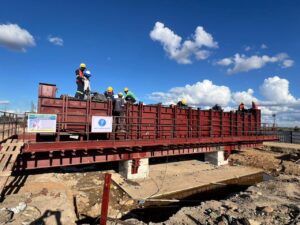
The Ministry of Transport and Infrastructural Development has announced a major technical milestone at the Mabvuku Interchange construction project, with the commencement of pier cap settings. This development marks a significant transition in the project’s timeline, moving from foundational substructure work to the assembly of the components that will eventually support the massive bridge deck.
Located at the intersection of the Harare-Mutare Highway and the Mabvuku-Tafara turnoff, the project is a central component of the government’s broader strategy to modernize the nation’s road network and eliminate chronic traffic congestion along the eastern corridor.
Pier caps are essential structural elements that sit atop the bridge columns, serving as the platform that distributes the weight of the superstructure down through the piers to the foundations. The successful setting of these caps is a precision-intensive process that requires meticulous engineering and heavy-lift coordination.
Once in place, the pier caps will allow for the installation of beams and the subsequent pouring of the concrete deck. Engineers on-site have noted that the project is maintaining a steady pace, following the successful completion of piling and abutment works earlier this year.
The Mabvuku Interchange is designed to replace the existing high-traffic junction with a modern overpass system. By elevating the main Harare-Mutare Road, the design will allow local traffic from Mabvuku and Tafara to flow seamlessly underneath, regulated by synchronized traffic signals. This separation of regional and local traffic is expected to drastically reduce the travel times for commuters and long-distance hauliers while significantly lowering the rate of accidents at what has historically been one of the city’s most notorious congestion hotspots.
Beyond the immediate logistical benefits, the project represents a vital investment in Zimbabwe’s regional trade competitiveness. As a key link on the Beira Corridor, the Harare-Mutare Highway facilitates the movement of bulk goods between the Port of Beira in Mozambique and the Zimbabwean hinterland. The Ministry is modernizing this node to ensure that the country’s infrastructure remains capable of supporting the increased trade volumes anticipated under Vision 2030.
As work continues toward the projected completion date later this year, the Ministry has reaffirmed its commitment to delivering world-class infrastructure through the “brick by brick” development model. The progress at Mabvuku, occurring alongside similar projects at the Msasa and Delport interchanges, underscores a comprehensive urban renewal program aimed at transforming Harare into a modern, efficient capital city.
For the residents of eastern Harare, this technical update is a clear signal that the days of traffic gridlock are nearing an end.