The revival of David Whitehead Textiles (DWT) has emerged as a flagship infrastructure success story under Zimbabwe’s National Development Strategy 2 (NDS2), with newly built and re-equipped factory capacity in Chegutu and Kadoma now driving one of the country’s most significant manufacturing comebacks in decades.
The turnaround has been anchored by a US$20 million investment from Agro-Value Chain Zimbabwe (AVCZ), a local agricultural consortium and subsidiary of the Indian-owned ETG Parrogate Group, which has procured and installed state-of-the-art textile manufacturing equipment to restore the factory’s operations to full capacity. Company chairman Pradyumn Ganediwal confirmed the pace of the rollout, noting that new equipment has been arriving steadily, with 20 containers already received at the plant.
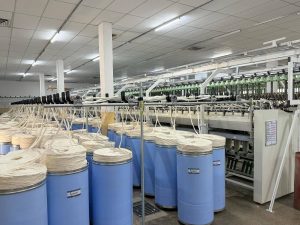
The physical infrastructure now spans two key sites. A parliamentary oversight tour took lawmakers through the Kadoma-based plant as well as David Whitehead’s spinning and weaving factory in Chegutu, giving officials a direct look at machinery installations that have transformed idle factory floors back into active production lines. ETG Group’s chief operations officer, Rodreck Musiyiwa, who is leading the revitalisation, reported that the factories can now produce as much as two million metres of fabric a month, with cotton yarn exports already underway.
The scale of ambition extends further. When the plant was officially commissioned, government projections indicated the fully revived facility would eventually be capable of churning out ten million metres of fabric annually, positioning it as the sole domestic manufacturer of fabric for military fatigues and school uniforms. Deputy Minister Vangelis Haritatos, touring the upgraded sites, highlighted the leap in technological capability, observing that the factories now house fully automatic production plants integrated at the heart of the operation.
Beyond the textile mills themselves, the infrastructure build-out has been complemented by a linked multi-million-dollar plant comprising a cotton ginning factory and an oil extraction facility capable of crushing cotton, soyabean, sunflower and canola seeds — creating an integrated value chain from raw cotton to finished fabric under one investment umbrella.
For Chegutu and Kadoma, the rebuilt factory infrastructure represents more than machinery; it signals renewed industrial activity in towns that had watched textile production decline for years. With production capacity climbing and exports resuming, DWT’s factory revival stands as a concrete test case for NDS2’s core promise: that rebuilding domestic manufacturing infrastructure can convert local cotton into local jobs, reducing Zimbabwe’s reliance on imported textiles while restoring one of its most storied industrial names.