Across Zimbabwe’s growing construction landscape, from high-rise developments in Harare’s central business district to sprawling industrial and retail projects on the city’s outskirts, a shift in how concrete is placed on site is quietly changing the pace and efficiency of building work. Concrete boom pumps, once a rare sight on Zimbabwean sites, are becoming an increasingly common feature of major construction projects, offering contractors a faster and more precise alternative to traditional methods of pouring concrete.
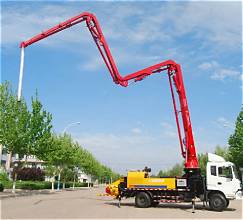
For decades, concrete placement on many Zimbabwean sites relied heavily on manual labour, wheelbarrows, chutes and static line pumps, methods that, while effective for smaller residential builds, become significantly less efficient as project scale and height increase. Boom pumps, mounted on truck chassis and fitted with a hydraulically controlled articulated arm, allow concrete to be delivered directly to precise locations on a site, including upper floors of multi-storey buildings, without the need for extensive manual transport or scaffolding-based delivery systems.
The appeal of boom pumps lies primarily in the combination of speed, accuracy and reduced labour dependency they offer. A boom pump can deliver large volumes of concrete continuously and with considerable reach, often extending tens of metres both horizontally and vertically, allowing contractors to pour foundations, slabs, columns and elevated structures with far greater efficiency than manual methods allow. This has become particularly relevant as Zimbabwe’s construction sector has seen a rise in multi-storey commercial and mixed-use developments, particularly along growth corridors such as Harare’s northern suburbs, the Borrowdale and Highlands areas, and emerging nodes along major highways where new retail and residential projects continue to take shape.
Beyond speed, boom pumps also offer contractors greater control over concrete quality during placement, reducing the risk of segregation or inconsistent compaction that can occur when concrete is transported manually over long distances or heights. This has made them particularly attractive for projects with strict engineering specifications, including bridges, industrial facilities and high-specification commercial buildings where structural integrity and finish quality are closely scrutinised.
The growing presence of boom pumps on Zimbabwean sites has also given rise to a small but developing local plant hire industry, with several companies now offering boom pump rental services to contractors who may not have the capital or ongoing project volume to justify purchasing such specialised equipment outright. For many local builders, hiring a boom pump for specific pours, rather than owning one, has proven a more practical route to accessing the technology, allowing even mid-sized contractors to benefit from faster placement times on larger pours without the capital outlay of equipment ownership.
As Zimbabwe’s construction sector continues to grow, driven by residential expansion, retail development and infrastructure investment, the use of boom pumps is likely to become increasingly standard on larger projects, mirroring trends already well established in more developed regional construction markets.
For an industry often working against tight timelines and rising material costs, the efficiency gains offered by mechanised concrete placement represent a meaningful shift, not merely a matter of convenience, but an increasingly necessary tool for delivering ambitious projects on schedule and to specification.