
The long-awaited infrastructural link connecting Enterprise Road to the existing Robert Gabriel Mugabe International Airport Road is officially moving into its execution phase, marking a significant milestone in Zimbabwe’s urban development strategy.
However, the most notable revelation accompanying the project’s commencement is the confirmation that the new bypass will operate under a tolling system. This development signifies a strategic shift in how major metropolitan arteries are funded and maintained, ensuring that the high-specification engineering required for the project is supported by a sustainable revenue model.
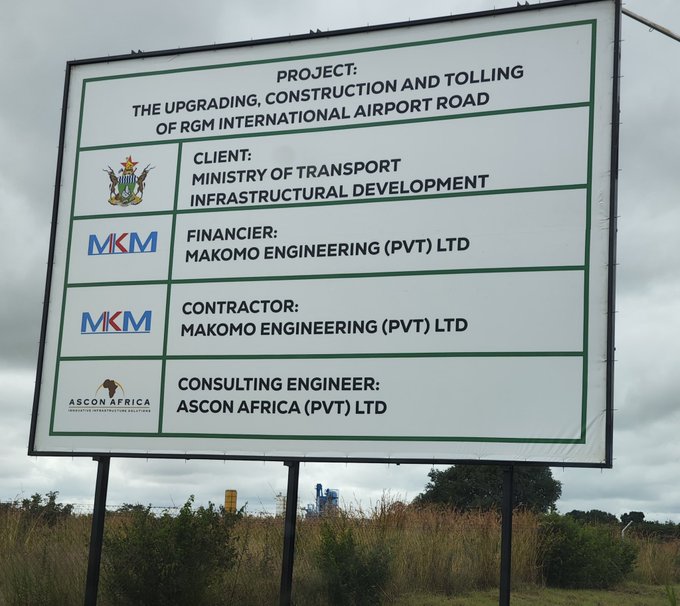
According to official project signage, the initiative is titled “The Upgrading, Construction and Tolling of RGM International Airport Road.” The project falls under the jurisdiction of the Ministry of Transport and Infrastructural Development, acting as the primary client.
In a move that highlights the growing importance of private-sector participation in national infrastructure, Makomo Engineering (Pvt) Ltd has been appointed as both the financier and the lead contractor. This dual role suggests a streamlined approach to project delivery, with Ascon Africa (Pvt) Ltd providing specialized oversight as the consulting engineers.
The centrepiece of this construction effort is the complex “road over rail” bridge, an engineering necessity designed to eliminate the bottleneck between Enterprise and the airport corridor. By elevating the roadway over existing railway lines, the project aims to drastically reduce transit times and improve safety at one of the city’s most congested intersections. This intersection has long been a point of frustration for commuters and freight operators alike, and its resolution is seen as a critical component of the broader RGM International Airport expansion.
The introduction of tolling on this specific urban route has sparked immediate discussion among stakeholders. While tolling is common on national highways connecting major cities, its application on a key suburban-to-airport link reflects a modern “user-pay” philosophy. The revenue generated through these tolls is expected to be ring-fenced for the long-term maintenance of the bridge and its surrounding road networks, preventing the deterioration that has historically affected un-tolled metropolitan routes.
As construction begins, the project represents more than just a new stretch of bitumen; it serves as a blueprint for the future of Zimbabwean infrastructure. The combination of the precision of Ascon Africa’s consulting with the financial and operational muscle of Makomo Engineering, will enable the Ministry to bet on a model that prioritizes longevity and efficiency. For the residents of Harare and international visitors, the completion of this route will provide a world-class gateway to the capital, funded by the very progress it facilitates.