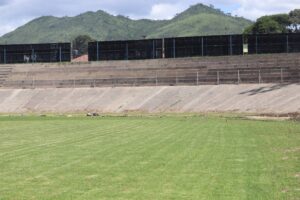
MANICALAND’S ceremonial home of football, Sakubva Stadium, is poised to become the first venue to host national team matches on home soil following a US$1,5 million refurbishment project.
The upgrade, driven by President Emmerson Mnangagwa’s Government through tax incentives on sports infrastructure, aims to bring the facility up to international standards.
The project, being carried out by a Chinese contractor in partnership with Mutare City Council, is expected to be a game-changer — marking a crucial step towards the return of national teams to home turf.
Zimbabwe was barred from hosting international fixtures since 2020, when the Confederation of African Football (CAF) ruled local stadia substandard after a November 2019 inspection.
Since then, the Warriors and other national sides have been forced to play their “home” matches outside the country.
Sports infrastructure construction falls under National Development Strategy (NDS2) Pillar Three, dealing with Infrastructure Development and Housing – with focus on upgrading, modernising, and expanding facilities to meet international standards (FIFA/CAF) to host major global events and promote sports tourism.
Key initiatives in NDS2 include building a new national stadium in Mount Hampden, refurbishing the existing National Sports Stadium, and expanding local facilities.
It is against this background that, after a thorough analysis and research into the FIFA requirements for match venues to host international matches, with the help of Zimbabwe Football Association (ZIFA) – Mutare City Council discovered that Sakubva Stadium is the low-hanging fruit, given the current construction model of superstructure, which is on the ground as opposed to suspended superstructures at the National Sports Stadium, Rufaro Stadium in Harare and Barbourfields Stadium in Bulawayo.
In an exclusive interview upon his return from China this week, where he led a delegation of experts from Mutare City Council as well as ZIFA, Town Clerk, Mr Blessing Chafesuka, confirmed that the facility will meet acceptable standards after completion of current renovations.
The scope of works for the project covers all components of the superstructure.
“The background of the project is that, as a country, we have a challenge in terms of stadia, yet football is the most loved sport in the country. As a city, we have committed ourselves to deliver a stadium that will enable national teams to play their home matches at home, and this is also part of our key projects for 2026. Upon completion, the stadium will meet acceptable standards to host international matches. From the assessment that we did together with ZIFA, we discovered that Sakubva Stadium offers the easiest or quickest route towards national teams’ return to home turf.
“This is simply because the current construction model of superstructure is on the ground, as opposed to suspended superstructures in other cities. The level of investment needed for a structure like Sakubva Stadium to meet acceptable standards is much lower compared to, for example, what is needed at the National Sports Stadium, simply because our stadium is sitting on firm ground,” said Mr Chafesuka.
Basic structural engineering works dictate that installation of bucket seats and other renovation works can affect the structural integrity of a suspended superstructure compared to one that is seated on the ground.
Sakubva Stadium will also have an upper hand in ensuring the return of the national teams to home soil, given that there is an airport and five-star hotel within the distance required by FIFA and CAF, to the match venue.
Mr Chafesuka also confirmed that work is already underway, with bucket seats secured in China expected to reach the Sea Port of Beira within seven weeks.
“When we left China, the bucket seats had already been loaded into containers and movement will be starting soon. It could have been delayed a bit by the Chinese New Year holiday, but we are expecting the consignment within 10 weeks, given that it will take seven weeks for it to reach the Sea Port of Beira,” he said.
Mr Chafesuka said the other advantage of Sakubva Stadium is that extensive works on the drainage and turf have already been covered, and the remaining scope of works will now cover components like media space, turnstiles, tunnels, changing rooms and ablution facilities.
“We are going to be upgrading the ablution facilities to meet international standards, as well as the turnstiles. Currently, we have four, and we will have 10 at the end of the renovations.
“We will also be having completely new changing rooms. We are also looking at a completely new VIP and VVIP sections of the stadium with different kinds of bucket seats. We will be having a new media section that meets the demands of the work of sports journalists.
“We had a ZIFA expert when we were in China, so that we could also get hands-on guidance on the standard material required,” he said.
For Mutare City Council to pursue this initiative, the Second Republic’s support measures on sports infrastructure facilities construction were a source of motivation, thus the municipality will shoulder the financial burden together with private sector players.
“As a council, we have already secured the bucket seats, and, like I said, they are on their way. However, we will make use of Government policies and incentives for sports infrastructure construction. We will have corporates that will come in for different components of the facility, and in return, they will get enticing tax rebates that are being provided for as per Government policy. For example, if a company pours in US$1 million into the Sakubva Stadium refurbishment project, they will enjoy a tax rebate of up to US$1,5 million. That is awesomely enticing,” he said.
Government support measures, including tax incentives, streamlined approval systems and improved access to finance, have strengthened confidence in the construction sector, encouraging both local and diaspora investors to channel capital into property and infrastructure development, in this case, infrastructure for sports.
Ideally, the initiative at Sakubva Stadium is set to be a huge contribution to the infrastructure-led growth model, which places roads, housing, industrial infrastructure and public utilities at the forefront of the nation’s transformation agenda.
According to the Zimbabwe Building Contractors Association, the industry has achieved an estimated 80 percent success rate in project delivery under the prevailing policy environment of the Second Republic, a huge leap from the past.