Ecobank Zimbabwe Limited, a key subsidiary of the pan-African banking group with a footprint spanning 33 countries, has marked a significant milestone with the relocation of its Head Office from 2 Piers Road to a purpose-built, world-class headquarters at No. 4 Piers Road in Borrowdale, Harare.
The move has not only elevated the architectural presence of this prestigious address but has also introduced a new reference point for contemporary corporate design. More than a conventional office block, the building is a physical expression of environmental stewardship and progressive innovation, redefining expectations for sustainable architecture in Zimbabwe.
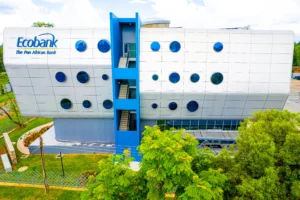
Innovative Frontage and Thermal Control
The building’s expansive glass façade is both visually commanding and highly performance driven. Constructed using advanced laminated glazing integrated with a solar-control coating, the envelope delivers controlled one-way visibility, ensuring internal privacy while preserving uninterrupted outward views. This solar-control layer plays a critical role in thermal regulation, limiting solar heat gain during peak temperature periods while reducing heat loss in cooler conditions. By moderating external thermal loads, the façade stabilizes internal comfort levels and significantly reduces reliance on energy-intensive mechanical heating and cooling systems.
Light and Sight
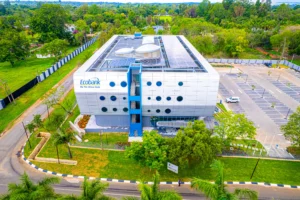
The building is designed to optimize daylight penetration, thereby reducing dependence on artificial lighting throughout the day. A defining feature is the bespoke skylight system formed from ETFE pillows which are specialized, air-filled membranes that provide superior thermal performance when compared to conventional glazing. These translucent cushions allow daylight to permeate the building’s central spaces while minimizing unwanted solar heat gain.
Water Harvesting and Advanced Engineering Ecobank Zimbabwe Limited’s Head Office exemplifies sustainable engineering through a closed-loop water management strategy that integrates an efficient internal reticulation system. All water outlets within the building are fitted with sensor-controlled fittings to regulate flow and minimize unnecessary consumption and wastage. A rainwater harvesting system has been installed, where all collected rainfall is stored and reused for ablution facilities within the building.
Furthermore, the design incorporates an advanced water recycling process in which greywater and harvested rainwater are channeled through an on-site wastewater treatment system that incorporates bio-digestion and ultraviolet (UV) disinfection. This process treats the water to a suitable standard before it is reused to support the landscaped gardens. This integrated
and closed-loop approach enhances the building’s water resilience while contributing to meaningful long-term conservation of this critical natural resource.
Robust Insulation and Modern Ventilation Thermal efficiency is further enhanced through the performance of the building’s physical envelope. The external walls and internal partitions incorporate a layered assembly comprising insulation, galvanized sheeting, and Aluminium Composite Panels (ACP), forming an effective thermal barrier. This envelope assembly reduces heat transfer and ensures that internal workspaces maintain comfortable conditions with minimal reliance on mechanical systems. This emphasis on performance extends to the building’s ventilation
strategy.
In response to internal recommendations to exceed the original design specification, the HVAC system was upgraded from MV6 to MV8 VRF technology. The enhanced system delivers improved indoor air quality, increased energy efficiency, and reduced operational noise levels.
Collaborative and Energy-Efficient Workspaces
The interior planning is guided by an open and collaborative workplace strategy. Through the introduction of strategically positioned open zones, the layout achieves a high degree of visual transparency, enabling clear sightlines across the floor plate. Importantly, the design deliberately limits the number of offices enclosed. This approach not only supports collaboration and interaction but also reduces demand for artificial lighting and localized air-conditioning, resulting in a workspace that is both energy-efficient and highly functional.
Achieving Global Accolades
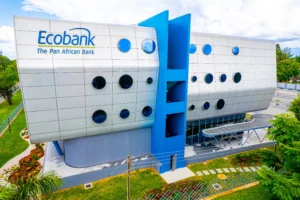
The project is a national pioneer, becoming Zimbabwe’s first development to achieve certification under the International Finance Corporation (IFC) EDGE programme; Excellence in Design for Greater Efficiencies. The Bank is progressing towards EDGE Advanced certification, an internationally recognized green building standard that benchmarks measurable reductions in operational energy use, water consumption, and embodied carbon within construction materials. The IFC has profiled Ecobank Zimbabwe Limited’s Head Office as a regional best-practice case study, positioning it as a reference project to encourage wider adoption of sustainable building standards across the SADC region.
Operational performance of the building is supported by an integrated Building Management System (BMS), reinforcing the Bank’s commitment to technologydriven efficiency and long-term asset optimization. The Bank acknowledges the collective contribution of all stakeholders involved in the successful delivery of this milestone.