
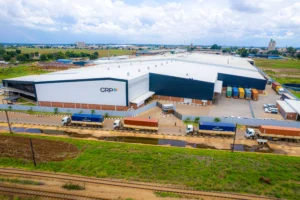
The unveiling of the multi-million-dollar Cut Rag Processors (CRP) facility in Lochinvar, Harare, on November 19, 2025, represented a watershed moment for the Zimbabwean economy. This investment is not merely an expansion; it is the establishment of a world-class processing powerhouse, instantly positioning CRP as one of Africa’s largest tobacco processing operations. The impressive facility, located on Green Trees Road, is a tangible sign of Zimbabwe’s commitment to industrialisation and value addition, objectives that lie at the heart of the national economic agenda.
Cutting-edge technology and processing might:
The new CRP plant is defined by the sophisticated German and Italian technology that fills its vast production halls, transforming raw leaf into finely crafted cut rag. This machinery represents a
significant upgrade, designed to deliver “more efficiencies and quality production process,” substantially enhancing the value proposition for CRP’s domestic and international customers. The core of the operation boasts advanced processing lines, including large cylindrical dryers and conditioning equipment likely sourced from specialists like Comas Tobacco Machinery of Italy.
This technology allows for precise conditioning, flavouring, and cutting, providing quality assurance at every stage to meet diverse taste profiles. Crucially, the plant incorporates commendable sustainability measures, most notably the use of wood blocks from timber waste as an alternative energy source. The sheer capacity of the new facility is overwhelming, designed to meet soaring global demand. The plant is engineered to process up to 3 million kilogrammes of cut rag per month.This expansion results in a production capacity that is almost triple that of CRP’s previous operations, enabling the company to process a significantly larger portion of the national tobacco crop into high-grade, export-ready products.
The architectural and engineering feat:
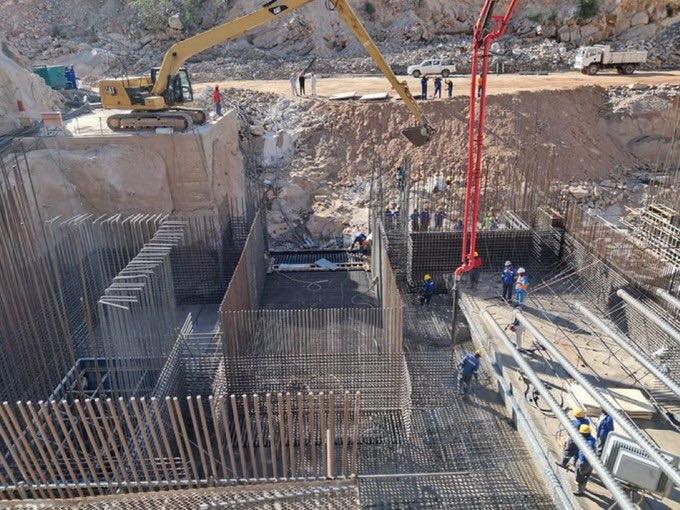
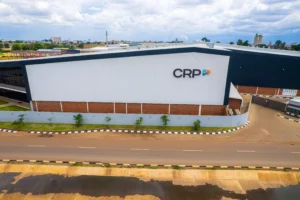
The structure housing this complex machinery is an architectural and engineering feat in itself. The design is based on a modern, functional concept that ensures operational hygiene and an efficient linear flow of the tobacco processing. The exterior is characterized by a large, modern facade of white and dark grey, showcasing a hightech industrial complex. The scale of the site is massive, encompassing an area of approximately 6 hectares (60,000 square meters), and the built area is more than 40,000 square meters. The main factory bays reach impressive heights of around 16 meters, requiring advanced structural engineering, including complex piling, ground beams, and the integration of two sets of ring beams for stability. The final structure is framed by concrete columns and features a durable brick skin.
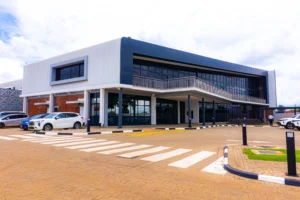
To ensure the foundation for the heavy machinery was perfectly level, the contractors, including civil engineering specialists like RADX Construction, employed cutting-edge construction technology. This included self-levelling technology using GPS to achieve 100% accurate slab levels. For the finishing, they utilized drive-on power floating and polishing machines instead of manual equipment, drastically boosting efficiency and accelerating the construction timeline, which began in October 2022 and was substantially complete a year prior to the official commissioning. The supporting infrastructure is equally expansive, including a paved parking area and dedicated driveways.
Project delivery and local content:
The successful delivery of the US$120 million facility mirrored the professionalism of local project management and labour. At its peak, the construction phase employed a massive workforce of 560 people across the main contractor and various subcontractors. The project management and cost control were handled by professional consultants,including Matrix Quantity Survey and
Project Managers (MQSPM), who served as the Quantity Surveyor for the facility, with key professionals like Richard Dodington (Project Manager) and Derek Landman (Registered Quantity Surveyor) involved in its proficient cost management and oversight.
The project relied heavily on local content, with key materials sourced within Zimbabwe. The concrete was supplied by Scribante, the bricks by Tiger Bricks, and the cement by Diamond Cement.
Local subcontractors were central to mthe operation, handling specialized works such as the steel structure (Pat Dunn and Brown Engineering), electricity (L. Electron), and bulk earthworks (R Davis). This extensive local procurement and employment aligns with the core goal of the investment: to stimulate economic activity across the entire Zimbabwean industrial ecosystem.
The commissioning of the CRP plant is a definitive marker of Zimbabwe’s progress toward an industrialized, value-adding economy. It is a symbol of technical prowess, massive scale, and a focused national ambition to compete at the very top of the global tobacco sector.