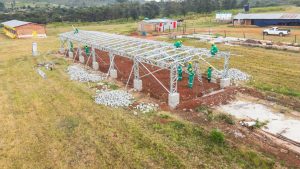
The Mistletoe Avenue Social Housing Project in Kununurra, completed by the Kullarri Building Company, demonstrated how local cold-formed steel (CFS) production combined with off-site fabrication and digitally integrated manufacturing could address the specific challenges of building in a remote location. According to Howick, whose roll-forming technology was used on the project, framing crews were able to complete individual houses in just one to two days, a dramatic reduction compared to conventional onsite timber or masonry framing methods.
Central to the project’s success was the decision to produce steel framing components locally rather than transporting pre-finished materials over long distances. This reduced the number of freight movements required, cut material waste generated during construction, and shortened the time crews spent working onsite, factors particularly valuable in remote or logistically challenging locations.
For Zimbabwe, where construction projects often contend with long supply chains, import costs on structural materials, and the logistical difficulties of building in more remote districts, the technology is no longer a distant concept. Companies such as Frameco have begun bringing cold-formed steel framing capability into the local market, allowing structural components to be produced to precise specifications and assembled rapidly on site, a development that signals Zimbabwe’s construction sector is starting to catch up with methods already proven in more established markets.
Digital fabrication, the process of converting architectural designs directly into manufacturing instructions for automated production, also stands to offer efficiency gains relevant to Zimbabwe’s growing construction sector. By reducing manual measurement and cutting errors on site, digitally integrated systems can improve consistency and reduce the rework that often adds cost and time to building projects.
Zimbabwe’s construction industry has increasingly turned to alternative building technologies in recent years, as developers seek ways to deliver housing and commercial projects more quickly amid rising demand for both residential stock and commercial infrastructure. With cold-formed steel framing now locally accessible, the technology offers a viable complement to traditional brick-and-block construction, particularly for social and affordable housing projects where speed and cost efficiency are critical.
As Zimbabwean developers, contractors and policymakers continue to explore ways to close the country’s housing deficit, the arrival of local CFS capability through companies like Frameco marks a tangible step in bringing global best practice home, offering local builders the same tools that helped cut freight, waste and construction time thousands of kilometres away in Western Australia.