BRAZIL is famous for many different reasons – the relaxed friendly people, a multi-cultural society, and a laid back way of life where people enjoy socialising at street side coffee shops, and excellent restaurants. Like Zimbabweans the Brazilians are also crazy about football and local music and, well… just having a good time and enjoying life with family and friends. Brazil is also known as one of the best producers of excellent quality coffee beans and grass fed natural beef, another two things they have in common with us Zimbos.
So it seems that Harare is more than ready for a Brazilian styled coffee shop combined with a fine dining restaurant and the best place for it to be would be in the Avenues area around the CBD where locals are hungry (pun intended) for a new eating, drinking and relaxing experience! Arplan Investments – a local Zimbabwean/ Israeli enterprise – realised the gap in the market for this unique kind of establishment. It’s a multi functional and ultra-convenient venue – a coffee shop in the front for a swift shot of your favourite flavour of caffeine, a delicious breakfast, a quick pizza or a sandwich or a light lunch – while the back section caters for more discerning customers who would like to enjoy a cocktail before their meal and a more leisurely top class dining experience
In true Brazilian style, well suited to Zimbabwean tastes, both the more trendy and hip front section and the more sophisticated back section offer both indoor and outdoor seating, and both are very family friendly. The chosen site seemed to be perfect for what the owners envisaged for their unique style of urban chic restaurant combined with a busy coffee shop. It is corner property on Fifth and Herbert Chitepo Avenues, close to the busy Fife Avenue Shopping Centre, convenient for inner city dwellers, day time office workers and execs, and easily accessible for people coming in from the suburbs.
There was an existing old colonial style house, built around 1921 according to the records, which had been extensively repurposed and redesigned during nearly a century of use. Initially a private residence it had been converted for use as offices and studios, and had sadly become somewhat neglected and run down. One of the main attractions was a fairly large space at the back of the house which had at one time been a garden, plus usable space in the front of the house. Most developers would have simply knocked down the old building, which was structurally a little dubious, and built the new venture from scratch.
It would have been yet another sad example of Harare’s architectural heritage vanishing under new developments. Fortunately the new owners were determined to preserve a priceless and irreplaceable part of the city’s history, and decided to incorporate as much of the old structure as possible, as well as re-using and recycling as much of the historic materials as they could. The owner’s concept was to add two structures front and back while still keeping as much as they could of the original house to form the ‘heart’ or centre of the new construction. While it’s a great example of caring for and preserving the city’s historic buildings for all the residents, and for our future, it would probably have made better financial sense to simply demolish it completely and start again from scratch.
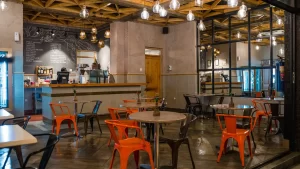
The original and very unconventional concept was to create two warehouse types of structures, front and back, embracing the old building on both ends. The warehouses would have a kind of industrial chic look which would be both functional and attractive – in a New York loft kind of way – providing most of the seating for the coffee shop and the upmarket restaurant. At the centre the heart of the building, and indeed the heart of the whole establishment, would be the old historic building containing the open plan kitchen (another unusual innovation for Harare), the pizza and pastry areas, the prep areas, the public restrooms and facilities, and the restaurant bar. It was a huge undertaking which involved gutting most of the old house and then reinforcing the walls with massive steel ring beams. As a lot of the interior walls had been removed more steel was required to span the new open plan layout and support the new ceilings. The extensive steelwork was fabricated and erected by Grid Transmission, often under very difficult circumstances.
It was impossible to bring a crane or other heavy machinery onto the site so most the steel beams had to be lifted into place by hand.
A new slab had to be cast when the suspended floors were lifted. The old corrugated iron roof of the original house was in need of extensive repairs but is still clearly visible, largely unchanged, as part of the structure invoking the colonial history of the site. A lot of the materials from the demolition process were lovingly preserved and recycled in the new build. The old pressed metal ceilings were recycled to become wall cladding, like a kind of embossed wallpaper, used in the restaurant. The Oregon pine floor boards were re-used as edging and cladding strips for the counters and the old wooden doors were re-used in the linking area between the coffee shop and the restaurant. In the central section the wooden cottage pane window frames looking onto the street were preserved, maintaining the old world historic charm and character.
Interestingly the blend of the old and the new industrial finishes works well, with the two very different architectural styles blending into a new kind of fusion. Some of the old outbuildings were renovated to become storage rooms and ablutions for the staff, while the walls facing into the back courtyard were refinished to complement the interior design. The broken down Durawall, which was not particularly attractive, was taken down and replaced with open steel palisade fencing, allowing diners to see out to the street and the passers-by and making the whole area feel more connected to the bustling streetlife. Even the outside street curbs and parking spaces were cleaned up and refreshed, showing the most dedicated attention to detail. The project was a very sensitive example of urban regeneration – a trend which we will hopefully see more of in the future.
Right from the start the owners worked closely with Kirsten Marx from KRM Space Design to oversee every aspect of the project from the structural work right down to the interior design finishes. Where new walls were needed they were built (by Monolith Construction) of exposed brick to add to the loft aesthetic and also to clearly differentiate the old and new structures. The steel structure in the front section allowed for the new roof to be high enough to incorporate aluminium bi-fold doors with high clerestory windows above helping to let in natural light.
Under the Chromadek roofs Alububble insulation was used to cut down on noise and help keep the temperature within a moderate range, also allowing the ‘ceiling’, made up of spaced wooden strips, to closely follow the roof line with no wasted space. Because there’s no ceiling void all the architectural tectonics – like the airconditioning and electrical ducting is exposed. The floor treatment helps to define separate areas, terracotta tiles for the outside areas, and a combination of porcelain tiles for high traffic areas, ceramic for lower traffic and Cemcrete for part of the seating area at the back.
Walls are a combination of exposed brick, some plastered areas with a painted blackboard finish which can be redrawn from time to time and with some walls clad with the old pressed metal ceiling boards. In the back courtyard part of the wall has been clad in beautiful steel plates which have been acid washed for an instant rust effect and then sealed with a clear varnish. The rusted steel works well with the brick and anodised aluminium door and window frames. Although it’s brand new all the ‘distressed’ elements add to the industrial look while blending with the historic parts of the building.
Most of the chairs, bar stools and tables were custom made to Marx’s fun and funky designs that are strikingly good looking, unique, and practical and comfortable. The lighting is an intriguing combination of ‘industrial chic’ bespoke pieces, some imported pieces, and some great exposed Edison type bulbs, although in the new energy efficient LED versions, sourced locally from Lighting World.
But the highlight of the interior design and decor – surprisingly – is the restrooms. It shows Marx’s witty sense of fun and design delight that so much attention to detail has been lavishly used in these usually somewhat neglected spaces. The recycled doors from the old house are re-used here, to create a kind of lobby area linking the front and back sections. Walls are dressed in vintage Portuguese black and white tiles (very typical of many Brazilian establishments) and the hand basins are glowing Copperwares bowls mounted on top of the counters, with brass plated taps. Circular mirrors are mounted in vintage steel frames – a lucky find from the auctions.
The open plan kitchen is the bustling heart of the establishment with a grill specially imported from Brazil, and a pizza oven clad in gold mosaic tiles. The menu, of course, includes a range of delicious steaks and beef dishes, but there’s something for everyone, including chicken and seafood dishes, salads and even vegetarian burgers. The bar has experienced mixologists who can whip up your favourite cocktail in Tom Cruise style and naturally they also serve the best coffee in town. It’s rapidly become an extremely popular venue so although the front section is on a casual drop in basis, booking is recommended for the restaurant. Call 0776300967 for a reservation. For more info about the structure and the decor contact Kirsten Marx at KRM Space Design Kirsten Marx [kmdesignzim@gmail.com]
text by Michael Nott